
Windowsills: The Unsung Hero of Masonry
By Mitch Bougard – Senior Advisor
Canadian Masonry Services | Ottawa, Canada
For over five decades, Canadian Masonry Services has provided expert restoration and masonry craftsmanship across Canada and the Caribbean. Our work is guided by one principle:
“Restoring yesterday’s works to today’s standards.”
This document, Windowsills: The Unsung Hero, reflects both our technical knowledge and our commitment to preserving the integrity of masonry through experience, code compliance, and pride in workmanship.
The Unsung Defender
Most people never notice their windowsills—until the masonry below begins to fail. The sill’s main job is simple but crucial: to catch and shed water before it can penetrate the wall. In Ottawa’s harsh freeze–thaw climate, that protection is essential.
Purpose and Function
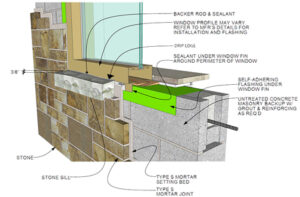
A properly designed sill projects beyond the wall, slopes downward (10–15°), and includes a continuous drip edge underneath. This detail prevents water from tracking back onto the wall face, keeping the brick or stone below dry and free of moisture-related damage.
Material Requirements
A windowsill must be waterproof and non-porous—its job is to shed water, not absorb it. Dense natural stone, cast concrete with low water absorption, or CSA-certified cementitious units are ideal. Materials like clay brick or CMU should be avoided because they absorb moisture, leading to staining, spalling, and freeze–thaw damage.
Drip Edge Specification
- Drip edge projection: ≥ 25 mm (1 in.) beyond wall face
- Drip groove: Continuous, 6–10 mm deep, and cleanly formed
- Purpose: Breaks surface tension and ensures water falls cleanly away
Two Common Mistakes in Sill Installation
- Interrupted Drip Edge: Breaks between sill joints let water cling to the wall.
- Protruding Masonry Below: Runoff lands directly on the wall, causing staining and freeze damage.
Prevention Tip: Keep the drip continuous and recess the masonry below so water falls cleanly away.
Material and Mortar Selection
Use dense, non-absorbent materials such as natural stone, concrete, or Adair limestone. Choose mortar Type S for strength, or Type N for flexibility. Always use a full-bed mortar and tight joints. Proper bedding ensures adhesion—no bonding agent required.
Custom Cementitious Sills
For custom cast sills, CSA-approved mixes guarantee low absorption, high compressive strength, and superior freeze–thaw resistance—critical qualities in Ottawa’s climate.
Proper Installation and Replacement
A. Custom Cementitious (CSA-Certified) Windowsills
- Clean cavity and remove debris.
- Install CSA-certified sill with a formed drip edge.
- Place a waterproof membrane between sill and masonry cavity to prevent freeze–thaw damage.
B. Arriscraft (Calcium Silicate) Windowsills
Arriscraft sills are autoclaved under steam and vacuum, making them dense and uniform—but not waterproof. They still require proper slope, membrane, and drip edge detailing for durability.
Membrane Importance (Code Requirement)
Both OBC 9.20.13.3 and NBC Part 9 require flashing or membrane separation at horizontal masonry interfaces. This prevents water entry and isolates the sill from trapped moisture.
Freeze–Thaw in Ottawa
Damage occurs around +1 °C to –1 °C when moisture repeatedly freezes and thaws. Each cycle expands trapped water, weakening the bond between brick and mortar. Proper sill design limits saturation and prevents spalling. Ottawa’s climate can see 60 or more of these cycles each winter—making proper sill detailing non-negotiable.
Codes and Standards
Our work meets or exceeds the following standards:
- OBC 9.20.13.3 – Slope & projection
- CSA A371:14 (2024) – Masonry Construction for Buildings
- NBC 2020 Part 9 – Moisture control & flashing integration
In other words, every sill we build follows the same standards used by architects and engineers in modern construction.
Craftsmanship, Experience, and Integrity
True craftsmanship lies in the details—slope, jointing, drip edges, alignment. Every windowsill installed by Canadian Masonry Services is hand-tooled, bonded, and leveled for long-term strength and durability.
With over 50 years of field experience across Canada and the Caribbean, we understand how sun, salt, and freeze–thaw cycles affect masonry. Different climates demand different detailing—a level of understanding that comes only through decades of craftsmanship.
Closing Thoughts
Next time you look at a building, check below the windows. If the masonry is clean and sound, it’s thanks to the unsung hero above—the windowsill. Built right, it protects your home for decades.
Need an expert to inspect or replace your windowsills?
Contact Canadian Masonry Services for a consultation or quote today. Proudly serving Ottawa and surrounding areas.
Follow us on Facebook •
Instagram •
LinkedIn
© 2025 Canadian Masonry Services. All Rights Reserved.
